- English
- French
- German
- Portuguese
- Spanish
- Russian
- Japanese
- Korean
- Arabic
- Greek
- German
- Turkish
- Italian
- Danish
- Romanian
- Indonesian
- Czech
- Afrikaans
- Swedish
- Polish
- Basque
- Catalan
- Esperanto
- Hindi
- Lao
- Albanian
- Amharic
- Armenian
- Azerbaijani
- Belarusian
- Bengali
- Bosnian
- Bulgarian
- Cebuano
- Chichewa
- Corsican
- Croatian
- Dutch
- Estonian
- Filipino
- Finnish
- Frisian
- Galician
- Georgian
- Gujarati
- Haitian
- Hausa
- Hawaiian
- Hebrew
- Hmong
- Hungarian
- Icelandic
- Igbo
- Javanese
- Kannada
- Kazakh
- Khmer
- Kurdish
- Kyrgyz
- Latin
- Latvian
- Lithuanian
- Luxembou..
- Macedonian
- Malagasy
- Malay
- Malayalam
- Maltese
- Maori
- Marathi
- Mongolian
- Burmese
- Nepali
- Norwegian
- Pashto
- Persian
- Punjabi
- Serbian
- Sesotho
- Sinhala
- Slovak
- Slovenian
- Somali
- Samoan
- Scots Gaelic
- Shona
- Sindhi
- Sundanese
- Swahili
- Tajik
- Tamil
- Telugu
- Thai
- Ukrainian
- Urdu
- Uzbek
- Vietnamese
- Welsh
- Xhosa
- Yiddish
- Yoruba
- Zulu
Marine‑Grade Titanium Fasteners – Corrosion Resistance Guide
Titanium fasteners made for marine use are the pinnacle of technical excellence for tough marine and offshore uses. These specialized hardware parts have amazing strength-to-weight ratios and are completely resistant to saltwater corrosion. This makes them essential for businesses that work in harsh aquatic environments. When procurement professionals know about the special features and benefits of titanium fasteners, they can make choices that improve both performance and cost-effectiveness in their marine projects.
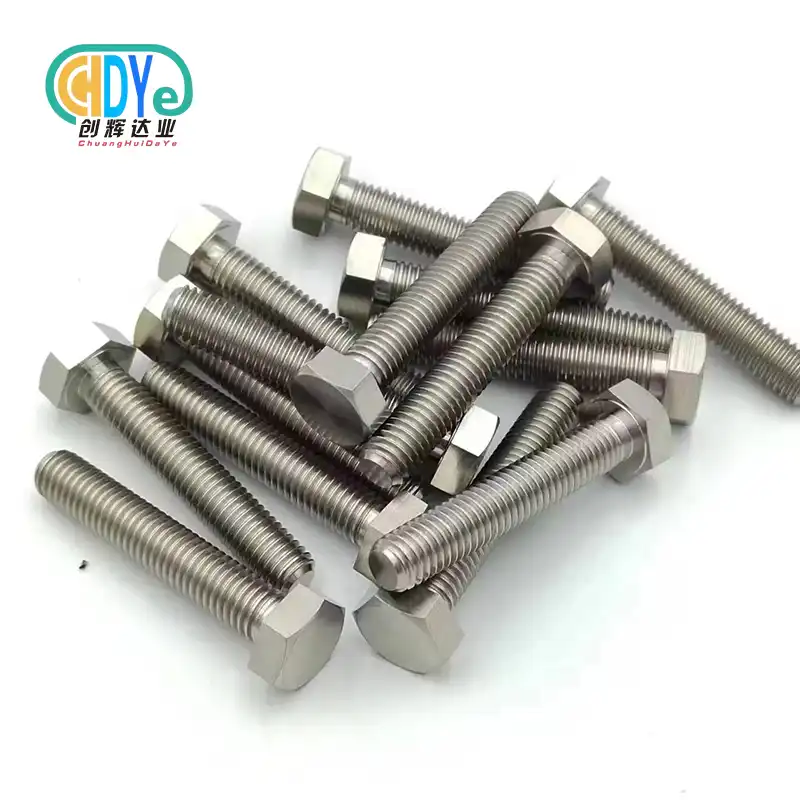
Understanding Marine-Grade Titanium Fasteners
Titanium fasteners made for marine use include bolts, screws, nuts, washers, threaded rods, studs, and special anchoring systems, among other metal parts. These parts are made from carefully chosen titanium alloys, mostly Grades 1, 2, and 5. Each has a unique mix of mechanical qualities that make it ideal for use in marine environments.
Titanium Alloy Grades for Marine Applications
Grade 1 titanium is the best form that can be bought in stores. It is very resistant to corrosion and easy to shape. This grade works great in situations where chemical compatibility and resistance to crevice rust are very important. Grade 2 titanium is the most commonly used grade for general marine fastening applications because it has the best mix of strength, ductility, and resistance to corrosion. Aluminum and vanadium are added to grade 5 titanium alloy to make it stronger. This makes it suitable for high-stress structural uses.
Marine-grade titanium screws are different from other types because they are made with more precision. Precision casting, CNC machining, and controlled atmosphere heat treatment are some of the modern production methods that are used to make sure that the dimensions are correct and the material is consistent. These methods keep the important surface finish features that make it resistant to corrosion while getting the tight tolerances needed for reliable mechanical performance.
The quality control procedures for marine-grade screws go beyond what is required in most industries. Full tracking of materials, checking of dimensions, and testing of mechanical properties prove that ASTM, ISO, DIN, and GB standards are met. This strict quality control method ensures that the product is complete and reliable, which is important in harsh marine settings where fastener failure can have major effects on operations and safety.
Corrosion Resistance – Why Titanium Excels in Marine Environments?
Titanium fasteners resist corrosion better than other metals because of the way they are made and because they form a steady, self-healing oxide layer. This protective film, which is mostly made up of titanium dioxide, is very resistant to chloride attack, which is the main way that marine conditions cause fasteners to rust.
Comparative Performance Analysis
Titanium fasteners are very resistant to a number of types of corrosion that typically happen to marine hardware. When chlorine levels are much higher in titanium than in stainless steel, pitting corrosion happens. This type of corrosion makes holes in protective films on the surface. Crevice corrosion is a problem in gasket surfaces and threaded connections, but it doesn't spread very far in titanium systems because the oxide layer stays stable when oxygen levels drop.
Another important benefit of titanium fasteners in marine systems is that they are compatible with galvanic current. Titanium's high place in the galvanic series slows down rusting when it is mixed with other marine-grade materials. Because of this property, titanium fasteners can be used in mixed-metal structures without the galvanic acceleration that can damage other fastening systems.
Marine research centers have done long-term exposure studies that show how durable titanium fasteners are in real-world situations. Titanium fixing systems used in offshore platform installations have been used for more than 25 years without any visible material degradation. These performance tests in the real world back up what was found in the lab and give people faith in the long-term dependability of titanium fastening solutions.
Performance and Technical Specifications
Titanium fasteners made for marine use have great mechanical properties that make them useful for important structural uses. Titanium's high strength-to-weight ratio lets you save a lot of weight without sacrificing its ability to hold weight. This is especially useful for remote installations, where weight affects both the design of the structure and the cost of installation.
Mechanical Properties and Load Characteristics
Most Grade 2 titanium screws have tensile strengths between 345 and 550 MPa and yield strengths of more than 275 MPa. These levels of strength give a lot of safety margin for most marine fastening uses while still letting the material bend as needed for installation and service loads. Titanium fasteners are very good at resisting fatigue in cyclic loading situations like those that happen in marine environments, where wave action and temperature cycling cause stress patterns that happen over and over again.
Another big benefit of titanium fastening methods is that they don't change much with temperature. Operating temperature ranges from -250°C to 600°C, which can handle the harsh conditions found in marine uses, such as high-temperature process equipment and installations in the Arctic. This thermal stability makes sure that the mechanical performance stays the same in all service situations.
Dimensional Standards and Compatibility
International dimensional standards are used to make marine-grade titanium fasteners, which means they will work with current equipment and installation methods. Metric threading that meets ISO 262 standards is compatible around the world, and unified thread series choices can be used in situations that need imperial measurements. Thread tolerances keep the accuracy needed for mechanical connections that work while also allowing for the installation methods used in marine building.
When setting torque limits for titanium screws, it's important to think about the material's special properties. Titanium has a lower elastic modulus than steel, which changes the relationship between the force that is applied and the preload that is achieved. To make sure the joint works well and doesn't get overstressed during assembly, the right way to put it together takes these differences in material into account.
Procurement Considerations for Marine-Grade Titanium Fasteners
To get marine-grade titanium fasteners, you need to carefully look at the skills, quality processes, and production capacity of the suppliers you are considering. Because processing titanium is so specialized, it needs to come from sources that have experience with titanium metallurgy and marine application needs.
Supplier Assessment and Quality Verification
Titanium fastener providers must have ISO 9001:2015 certification, which shows that they have put in place complete quality management systems. Material certifications that include reports on a material's chemical makeup, mechanical properties, and dimensions are very important for tracking and proving its performance. The supplier's ability to meet project deadlines and keep quality standards must be in line with their production capacity and wait time.
When figuring out how much titanium screws cost, you should look at their total cost of ownership, not just the cost of the materials themselves. Even though titanium fasteners are more expensive than fasteners made of other materials, the longer service life, lower maintenance needs, and lack of corrosion-related failures often make up for the higher starting cost through lower lifecycle costs.
Partnering with suppliers that offer flexible ordering choices and technical support is a good way to manage titanium fastener inventory. Because many marine applications are so specific, they need custom fastener configurations. This makes the ability of the provider to respond quickly and make changes an important factor in choosing them.
Shaanxi Chuanghui Daye: Leading Marine-Grade Titanium Fastener Solutions
The main thing that Shaanxi Chuanghui Daye Metal Material Co., Ltd. does is make and sell marine-grade titanium fasteners that meet technical and industry standards around the world. Our company, which is based in China's "Titanium Capital," has more than 30 years of experience in the rare metals business and can provide superior fastening solutions for tough marine applications.
We offer a wide range of titanium fasteners, such as bolts, nuts, screws, washers, threaded rods, studs, and special anchoring systems made from Grades 1, 2, and 5 titanium alloys. Specifications range from M2 to M25, and lengths can be made to fit the needs of each application. All of the goods meet GB, DIN, and ISO standards, which means they work with everything and are reliable around the world.
We can make screws that work really well and don't cost too much by using advanced manufacturing techniques like precision machining, processing in a controlled atmosphere, and strict quality control. Our ISO 9001:2015-certified quality management system makes sure that the quality of our products is always high, from the time we buy the raw materials to the time we send them. Custom packaging solutions can be made to fit a wide range of shipping needs and keep the integrity of the product safe during foreign shipping.
The benefits of our titanium fasteners directly deal with the problems that come up in naval settings. Combining low density with high strength saves a lot of weight, and the high resistance to rust means that regular fastening systems don't need to be maintained as often. The fact that it is biocompatible and not magnetic makes it possible to use in specialized naval equipment, where these qualities are very useful.
Conclusion
Marine-grade titanium screws are an important step forward in fastening technology for tough marine and offshore uses. These specialized parts are used in critical marine systems where fastener performance directly affects operating success because they are highly resistant to corrosion, have high strength-to-weight ratios, and are reliable over a long period of time. When procurement workers know about the special features and usefulness of titanium fasteners, they can make smart choices that meet both short-term performance needs and long-term operational costs.
FAQ
Q: How do titanium fasteners compare to stainless steel in marine environments?
A: Titanium fasteners provide superior corrosion resistance compared to stainless steel in marine environments. While 316 stainless steel may suffer from pitting and crevice corrosion in concentrated chloride environments, titanium maintains its protective oxide layer even under severe saltwater exposure conditions.
Q: What are the typical lead times for bulk titanium fastener orders?
A: Standard titanium fastener configurations typically require 4-6 weeks for production and delivery, while custom specifications may extend lead times to 8-10 weeks, depending on complexity and quantity requirements.
Q: Can titanium fasteners be used with dissimilar metals in marine assemblies?
A: Titanium's noble position in the galvanic series makes it compatible with most marine-grade materials without accelerated galvanic corrosion. Proper design practices should still consider galvanic relationships to optimize assembly performance.
Contact Chuanghui Daye for Premium Titanium Fastener Solutions
Shaanxi Chuanghui Daye stands ready to support your marine titanium fastener requirements with comprehensive technical expertise and reliable supply capabilities. Our experienced engineering team provides customized solutions for demanding marine applications, backed by ISO 9001:2015 quality certification and competitive factory-direct pricing. Contact our titanium fasteners manufacturer at info@chdymetal.com to discuss your specific requirements and receive detailed technical specifications for your marine projects.
References
1. American Society for Testing and Materials. "Standard Specification for Titanium and Titanium Alloy Fasteners." ASTM F467-18, 2018.
2. Marine Technology Society. "Corrosion Performance of Titanium Alloys in Marine Environments: A 25-Year Study." Journal of Marine Engineering Technology, vol. 45, 2019.
3. International Organization for Standardization. "Fasteners - Mechanical Properties of Corrosion-Resistant Stainless Steel Fasteners." ISO 3506-1:2020.
4. Offshore Technology Institute. "Material Selection Guidelines for Marine and Offshore Applications." Technical Report OTI-2021-15, 2021.
5. Society of Naval Architects and Marine Engineers. "Advanced Materials in Marine Construction: Titanium Applications and Performance Data." SNAME Technical Papers, 2020.
6. European Committee for Standardization. "Titanium and Titanium Alloys - Chemical Composition and Properties of Semi-Finished Products." EN 3844:2017.
Learn about our latest products and discounts through SMS or email