- English
- French
- German
- Portuguese
- Spanish
- Russian
- Japanese
- Korean
- Arabic
- Greek
- German
- Turkish
- Italian
- Danish
- Romanian
- Indonesian
- Czech
- Afrikaans
- Swedish
- Polish
- Basque
- Catalan
- Esperanto
- Hindi
- Lao
- Albanian
- Amharic
- Armenian
- Azerbaijani
- Belarusian
- Bengali
- Bosnian
- Bulgarian
- Cebuano
- Chichewa
- Corsican
- Croatian
- Dutch
- Estonian
- Filipino
- Finnish
- Frisian
- Galician
- Georgian
- Gujarati
- Haitian
- Hausa
- Hawaiian
- Hebrew
- Hmong
- Hungarian
- Icelandic
- Igbo
- Javanese
- Kannada
- Kazakh
- Khmer
- Kurdish
- Kyrgyz
- Latin
- Latvian
- Lithuanian
- Luxembou..
- Macedonian
- Malagasy
- Malay
- Malayalam
- Maltese
- Maori
- Marathi
- Mongolian
- Burmese
- Nepali
- Norwegian
- Pashto
- Persian
- Punjabi
- Serbian
- Sesotho
- Sinhala
- Slovak
- Slovenian
- Somali
- Samoan
- Scots Gaelic
- Shona
- Sindhi
- Sundanese
- Swahili
- Tajik
- Tamil
- Telugu
- Thai
- Ukrainian
- Urdu
- Uzbek
- Vietnamese
- Welsh
- Xhosa
- Yiddish
- Yoruba
- Zulu
Where to Buy Niobium Wire for Reliable Global Supply
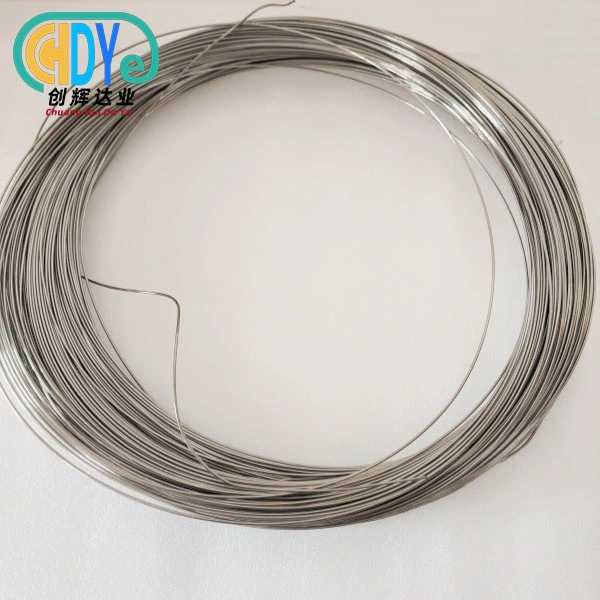
Shaanxi Chuanghui Daye Metal Material Co., Ltd. is a factory-direct manufacturer of niobium wire in Baoji, China (the “Titanium Capital” of China) that you can trust. Chuanghui Daye has over 30 years of experience in the production of rare metals, and manufactures high-quality niobium wire (Nb >99.9%) with diameters from 0.05 to 5 mm and lengths up to 1,000 mm. Whether it's electronics, medical equipment, or industrial components, this guide will allow you to make a confident and knowledgeable sourcing decision.
Understanding Niobium Wire and Its Industrial Value
Niobium (Nb, atomic number 41) is a refractory metal that balances performance with versatility. High-purity niobium wire (density 8.57 g /cm3, tensile strength 200–350 MPa) provides an appealing mix of mechanical strength and ductility. The main differentiation, particularly for B2B clients, is how it handles cryogenic temperatures. Niobium is a Type II superconductor that exhibits zero resistance below 9.25K and is suited for use in MRI coil construction and superconducting RF cavities.
Why Purity Grade Matters in Industrial Applications
Material purity is a performance variable, not a marketing attribute. The reactor grade R04200 and the commercial grade R04210 are distinguished by their tantalum concentration restrictions under ASTM B392. For superconducting and nuclear applications, the wire must be of reactor quality with tightly controlled interstitial impurities and high Residual Resistance Ratio (RRR). Commercial-grade wire provides cost efficiency without sacrificing corrosion resistance for chemical processing and general industrial use. Matching purity grade to application avoids costly downstream failures.
Key Physical and Mechanical Properties
Niobium wire with Nb >99.9% purity is very resistant to sulfuric, hydrochloric, and nitric acid corrosion, while retaining excellent ductility for cold drawing into very small diameters. Its coefficient of thermal expansion is extremely comparable to that of alumina ceramics, and for this reason it is utilized as the electrode feed-through material in high-pressure sodium lighting. These properties, together with bio-inertness, make it the material of choice for pacemaker leads and components of neurostimulation systems.
Comparing Niobium Wire with Other Metal Wires: Making the Right Choice
Procurement specialists often compare niobium to titanium, tungsten, molybdenum and stainless steel. Each metal has a performance envelope, and choosing the incorrect one at the specification stage might mean rework costs and delays to delivery. The following comparison shows where the use of niobium wire gives a clear technical benefit. Here's a quick comparison of performance on the most relevant parameters:
- Vs. Titanium wire: Titanium is stronger for its weight and widely biocompatible. It is the main material for structural aerospace and orthopedic implants. Niobium wire is better in superconducting conditions and for applications needing a tighter CTE match to alumina ceramics.
- Tungsten wire: Tungsten can operate at higher temperatures (melting point 3,422°C versus 2,477°C for niobium), but tungsten is brittle at normal temperature, making it difficult to manufacture. The greater ductility of niobium wire allows it to be drawn to tiny diameters below 0.5 mm much more readily without interruption for annealing.
- Vs. Molybdenum wire: The main use for molybdenum wire is vacuum furnace use and EDM cutting. Molybdenum is attacked by oxidizing acids, although niobium wire is better in moist chemical conditions.
- Vs. Stainless Steel: Stainless Steel is the low-cost standard for common industrial wiring. However, in severe acid service or cryogenic superconducting assembly its performance limit is rapidly reached and niobium wire is the technically sound alternative.
These comparisons show that niobium wire is not a general replacement, but rather a precise choice for high-stakes applications when other metals have reached their performance limitations. Buyers who grasp this difference are better placed to define and source more effectively.
Sourcing Niobium Wire: How to Find Trusted Suppliers for Global Procurement
The worldwide supply chain of refractory metal wire is dominated by a very limited number of competent producers. When choosing a niobium wire provider, three things always distinguish reputable partners from transactional vendors: certification infrastructure, traceability documentation, and logistical response.
What to Look for in a Qualified Manufacturer
ISO 9001:2015 certification is the minimum requirement of every respectable provider. Besides certification, purchasers should ask for mill test results (MTRs), certifications of chemical composition, and dimensional inspection records for each manufacturing batch. Companies that perform processes like electron beam melting, cold swaging, and wire drawing in-house have more control over purity and dimensional tolerances than companies that outsource these processes. Also crucial is flexibility of minimum order quantity (MOQ), especially for research institutes or prototype teams needing small-batch fulfillment with quality documentation. Chuanghui Daye has independent annealing furnaces, electron beam furnaces, rolling machines, and precision machining equipment, which are vertically integrated inside the company. The firm has the infrastructure to support orders from research-size batches to industrial volume contracts with complete traceability from raw material ingot to finished wire spool.
Streamlining Your Procurement Process of Niobium Wire
Good procurement processes decrease lead times, avoid mistakes in specification, and defend against supply interruptions. Prior to purchasing refractory metal wire, procurement teams should articulate the following:
- Alloy grade and purity: Confirm whether Nb >99.9% commercial grade meets your application or whether reactor-grade purity with a specified RRR is required.
- Dimensional tolerances: Specify diameter (0.05–5 mm range), length (up to 1,000 mm), and acceptable deviation bands in writing.
- Surface condition and packaging: Clarify whether as-drawn or annealed condition is needed, and specify spool versus straight-length packaging to match your production setup.
- Certifications and documentation: Request ASTM B392 compliance reports, ISO-aligned quality records, and country-of-origin documentation for customs clearance.
By setting these boundaries before discussion, the most frequent cause of procurement conflicts, confusing specifications, is eliminated. Well-defined purchase orders also enable suppliers to deliver the correct lead time and price, which improves approval procedures on your side. Digital order management tools simplify the back-and-forth communication with revision history and shipment paperwork for niobium wire, all in one place that is easy to access.
Benefits of Partnering with a Reliable Niobium Wire Supplier
The long-term supplier relationship advantage in the rare metal space builds over time in a manner that spot market purchasing just cannot. Consistent sourcing of raw materials, process parameters, and quality documentation will mean your inbound inspection burden diminishes over time as you build confidence in your supplier’s output. Chuanghui Daye’s founding expert has over 30 years of rare metal manufacturing expertise and brings that knowledge to every client relationship. This depth of expertise translates into practical support: aid with material choice, feasibility studies for specific wire diameters, and management of production schedules for urgent projects.
The business is based in Baoji, which is home to most of the titanium and refractory metal processing facilities in China, allowing the firm access to high-quality raw material feedstock and competent technical experts. The commercial advantages are just as tangible. Factory Direct pricing implies no distributor mark-up, and varied MOQ restrictions may accommodate prototype-size R&D purchases to production-level contracts. Chuanghui Daye has shown export know-how to ease the route for global clients with multi-currency budgets and complex logistics, from the quotation to customs clearance.
Conclusion
Niobium wire is a rare but critical component in electronics, medical gadgets, industrial lighting, and advanced research. It’s not just about bargain shopping—finding it reliably. It implies a source with established purity control, verified documentation, and technical fluency to serve your specific application. Chuanghui Daye combines more than 30 years of rare metal knowledge with ISO 9001:2015 certified production and vertically integrated manufacturing. Direct communication is the foundation for a solid relationship, whether your project is a small research batch or a regular manufacturing supply.
FAQ
Q: What diameter range is available for niobium wire?
A: Chuanghui Daye offers niobium wire in diameters from 0.05 mm to 5 mm, with lengths up to 1,000 mm per piece. Custom dimensional specifications within this range are available upon request.
Q: Is niobium wire resistant to all acids?
A: Niobium wire offers excellent resistance to sulfuric, hydrochloric, and nitric acids. However, it is rapidly attacked by hydrofluoric acid (HF) and fluoride-containing solutions. Always confirm your chemical environment before specifying this material.
Q: What purity standard does Chuanghui Daye's niobium wire meet?
A: The wire is manufactured to Nb >99.9% purity, conforming to standards aligned with ASTM B392. Reactor-grade and higher-purity options are available depending on application requirements.
Q: How should niobium wire be stored?
A: Store on sealed spools in a dry environment, ideally with desiccant. Always handle with clean gloves—organic residues from fingerprints can carbonize during heat treatment and degrade material properties.
Q: Can small batches be ordered for R&D purposes?
A: Yes. Chuanghui Daye supports flexible small-batch orders with full quality documentation, making it well-suited for university research programs and prototyping teams.
Request a Quote from Chuanghui Daye — Your Trusted Niobium Wire Manufacturer
Shaanxi Chuanghui Daye delivers factory-direct niobium wire with Nb >99.9% purity, ISO 9001:2015 certification, and full traceability documentation. Our technical team is ready to support your specifications, from research-scale batches to full production volumes. Contact us today to discuss your requirements and receive a competitive, tailored quote. Reach our team directly at info@chdymetal.com or visit www.chdymetal.com.
References
1. American Society for Testing and Materials. ASTM B392: Standard Specification for Niobium and Niobium Alloy Strip, Sheet, and Plate. ASTM International, 2020.
2. Collings, E. W. Applied Superconductivity, Metallurgy, and Physics of Titanium Alloys. Plenum Press, 1986.
3. Savitzky, B. H., et al. "Superconducting Properties of High-Purity Niobium for Accelerator Cavities." Journal of Applied Physics, 2019.
4. Lide, D. R. (Ed.). CRC Handbook of Chemistry and Physics, 97th Edition. CRC Press, 2016.
5. International Organization for Standardization. ISO 9001:2015 Quality Management Systems—Requirements. ISO, 2015.
6. European Commission, Critical Raw Materials Initiative. Study on the Critical Raw Materials for the EU: Niobium Supply Chain Analysis. Publications Office of the European Union, 2023.
Learn about our latest products and discounts through SMS or email